If you haven’t walked down La Rambla, have you even been to Barcelona? It’s a question that divides locals and travelers alike. Depending on who you ask, La Rambla is either the pulsating heart of Catalan culture or a gauntlet of selfie sticks and overpriced frozen pizza.
The truth, as with most things in Spain, lies somewhere in the middle—usually near a flower stall and a guy selling a dancing solar-powered cactus. Stretching from the bustling Plaça de Catalunya down to the shimmering Mediterranean Sea, this 1.2-kilometer pedestrian boulevard is iconic, chaotic, and utterly unavoidable.
Whether you’re a wide-eyed first-timer or a seasoned traveler who knows exactly which alleyway leads to the best vermouth, La Rambla demands your attention. But is it actually more than just a tourist street? Let’s lace up our walking shoes and find out.
A Quick History: From Riverbed to Runway
The name “La Rambla” doesn’t sound particularly Spanish, and that’s because it’s rooted in the Arabic word ramla, meaning “sandy riverbed.”
Centuries ago, this wasn’t a place for buying postcards; it was a seasonal watercourse that ran outside the city walls. When the rains came, it was a muddy mess; when it was dry, it was a convenient path. By the 14th century, the city expanded, the walls moved, and the river was diverted. What was once a drainage ditch gradually transformed into a promenade for the elite to show off their Sunday best.
By the 19th century, it became the cultural artery of the city. While the rich headed to the Gran Teatre del Liceu for opera, the working class gathered at the kiosks to argue about politics. Today, the “river” is made of people, and the only thing flowing is a steady stream of sangria.
One Street, Many Names
Technically, it’s not just one street. It’s Les Rambles (plural), a series of five distinct sections that flow into each other like a very long, very loud Spanish sentence.
- Rambla de Canaletes: Home to the famous Canaletes Fountain. Legend says if you drink from it, you’ll inevitably return to Barcelona. (It’s also where Barça fans gather to celebrate titles, so expect chaos if the local team wins).
- Rambla dels Estudis: Named after a 16th-century university, though nowadays you’re more likely to study the art of avoiding slow-walking tour groups.
- Rambla de les Flors: This is the soul of the street. It’s the only place where the fragrance of fresh lilies manages to overpower the smell of nearby waffle stands.
- Rambla dels Caputxins: Where you’ll find the Liceu Opera House and the entrance to the stunning Plaça Reial.
- Rambla de Santa Mònica: The final stretch leading to the sea, traditionally filled with street artists and painters.
Walking the whole length takes about 20 minutes if you’re a New Yorker on a mission, or three hours if you stop to look at every magnet.
The Atmosphere: Embracing the “Human Traffic Jam”
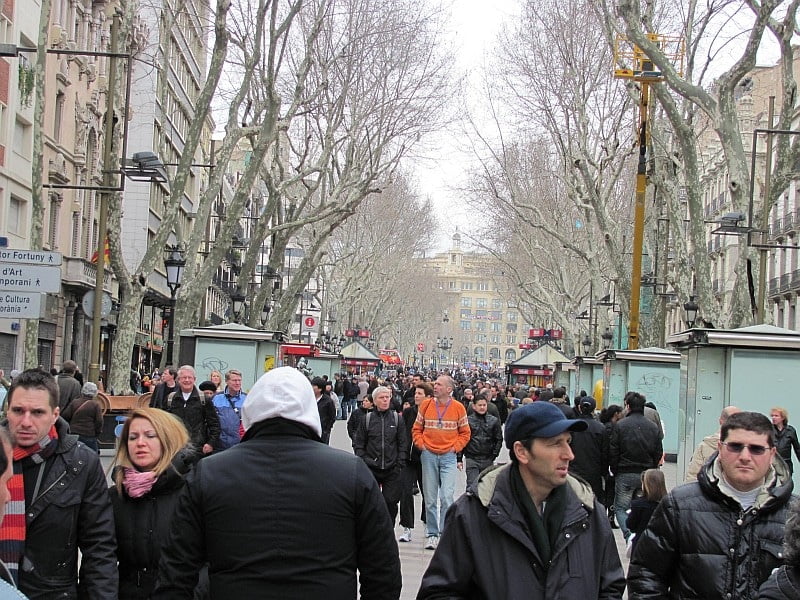
Let’s be honest: La Rambla is crowded. In the peak of summer, it feels like the entire population of Europe decided to meet in the middle of the street to check Google Maps at the exact same time.
The atmosphere is a high-energy mix of street performers, frantic waiters, and tourists looking for major attractions in Barcelona. It is loud, it is vibrant, and yes, it can be overwhelming.
A Note on Pickpockets
We have to talk about it. Barcelona has a bit of a “reputation,” and La Rambla is the stage for its most talented street magicians—the kind who make your wallet disappear without you noticing.
- Don’t be an easy target: Keep your bag in front of you.
- The “Bird Poop” Scam: If a “helpful” stranger points out a stain on your shoulder and offers to clean it, they aren’t being nice; they’re checking your pockets.
- The Shell Game: If you see people betting money on a ball under three cups, just keep walking. The only person winning is the guy running the game and his three “friends” pretending to be tourists.
Shopping: From Masterpieces to Mimosa Magnets
The shopping on La Rambla is a wild spectrum of “I need this for my living room” and “Why does this exist?”
- The Flower Stalls: These are the real deal. They’ve been here for generations, and they give the street its characteristic color. Even if you aren’t buying a bouquet, they are beautiful to look at.
- Kiosks: You’ll find international newspapers, books, and postcards. It’s a throwback to a pre-digital era that still feels charming.
- The Souvenir Shops: Brace yourself for an endless supply of “I ❤️ BCN” shirts, plastic flamenco dancers (ironic, since flamenco is originally from the south of Spain), and FC Barcelona scarves.
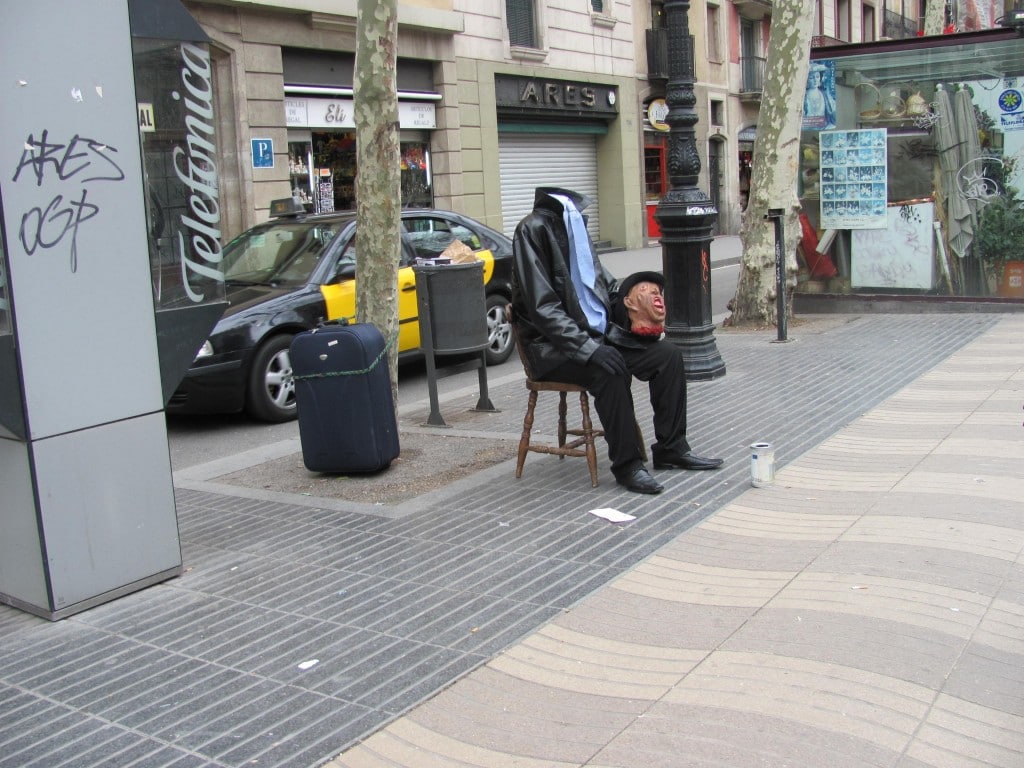
- Street Artists: Near the bottom of the street, you’ll find talented caricaturists and painters. It’s a great place to pick up a unique sketch, though be prepared to sit still while a stranger exaggerates the size of your nose for €20.
Dining on the Edge (of Sanity)
Dining on La Rambla is the ultimate litmus test for travelers. You will see dozens of terraces with glossy, laminated menus featuring photos of paella that looks suspiciously like it was printed in 1994.
The Golden Rule: If the menu is in five languages and there’s a waiter outside trying to “invite” you in, you are in a tourist trap. You will likely pay €18 for a “jumbo” sangria that is 90% ice and 10% regret.
However, if you just want to sit, people-watch, and enjoy the sun with a coffee, go for it! Just know you’re paying for the view, not the culinary excellence. For a real food experience, duck into the Mercat de Sant Josep de la Boqueria. It’s right off the street and offers everything from fresh oysters to cones of salty Iberian ham. If you’re looking for more refined evening plans, check out what’s happening in Barcelona for dinner-and-show options nearby.
The Mediterranean Heat Factor
If you visit in July or August, La Rambla doesn’t just feel like a street; it feels like a convection oven. The combination of stone pavement, thousands of human bodies, and the humid Mediterranean air can push the “feels like” temperature well into the 30s (°C).
- Pro Tip: Walk on the sides under the shade of the plane trees.
- Hydrate: There are public drinking fountains (like the Canaletes) that are safe and free.
- Time it right: Avoid the 1:00 PM to 4:00 PM window unless you enjoy the feeling of melting like a Dali clock.
Practical Tips for the Savvy Traveler
To enjoy La Rambla without losing your mind (or your phone), follow these tips:
- Go Early: Between 8:00 AM and 10:00 AM, the street is actually peaceful. You’ll see the flower stalls setting up and locals grabbing a quick espresso.
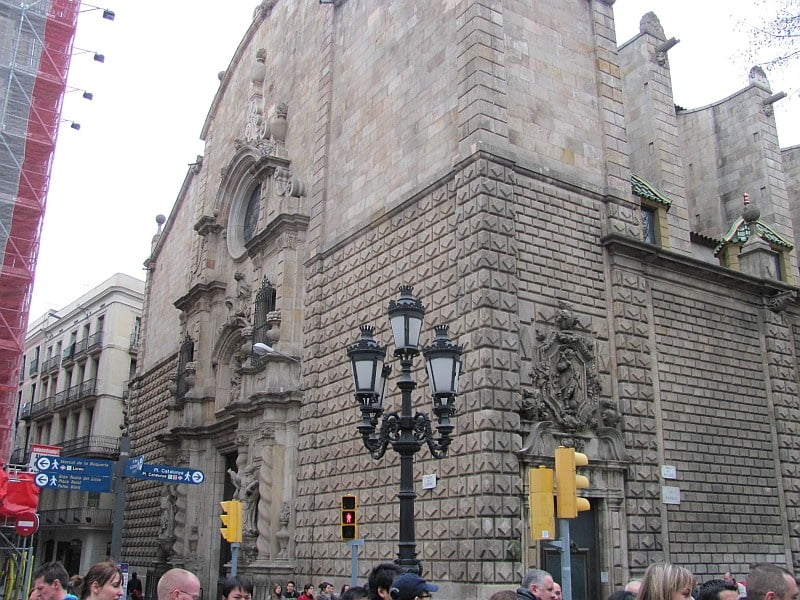
- Look Up: The ground level is chaos, but the architecture above the shops is stunning. You’ll see beautiful modernist balconies and intricate stonework that most people miss because they’re looking for the nearest gelato shop.
- Use the Side Streets: The Gothic Quarter (Barri Gòtic) and El Raval are literally steps away. Use La Rambla as your compass, but don’t be afraid to veer off into the narrow alleys where the real Barcelona hides.
- The “Pass-Through” Strategy: If you’ve seen it once, you don’t need to walk the center every time. Use the sidewalks on either side to move faster.
Is it Worth It?
So, is La Rambla “more than a tourist street”?
In many ways, no. It is the definition of a tourist street. But that doesn’t mean it’s bad. It’s a theater of human life. It’s where the city breathes, shouts, and sells souvenirs. It is the gateway to the sea and the historical pulse of the city. According to the Official Barcelona Tourism Portal, it remains one of the most visited spots in Europe for a reason.
Even for the most cynical traveler, there is a moment—usually right as the sun is setting and the lights of the Liceu flicker on—where La Rambla feels magical. Just keep your hand on your wallet and your eyes on the architecture, and you’ll do just fine.
La Rambla pictures